Category: Unusual Places & Things

  • Journey To Middle Earth At The Wieliczka Salt Mine in Poland

    Journey To Middle Earth At The Wieliczka Salt Mine in Poland

    There are plenty of things to do in Krakow, like visit the New Jewish Cemetery, the Pharmacy Museum or the Plac Nowy Jewish Market. There are also plenty of other activities you can do just outside of the city, like making the short journey to Wieliczka to see out the world’s oldest salt mine, dating back to the 13th century.

    While touring a salt mine doesn’t top most people’s travel bucket lists, you might be surprised to learn that about 1.2 million people visit this UNESCO World Heritage site every year, including the likes of Pope John Paul II and Bill Clinton.

    For me, the idea of making a “journey to Middle Earth” to depths of 135 meters, seeing the cathedral carved out of salt, and observing various works of salt art appealed to my fondness for all things weird and offbeat sites.

     Book a Wieliczka guided tour with KrakowBooking.

    All About The Wieliczka Salt Mine in Poland

    An excursion to the Wieliczka Salt Mines is probably one of the most touristy things you do in Krakow. I easily booked a half-day tour through my hostel. The tour even included pick-up and drop-off services so you can avoid the stress of rushing to a meeting point and/or figuring out how to get there on your own. We recommend, this Wieliczka salt mine tour!

    Arriving at the site, the group waited around while our coordinator fetched the tickets and took care of other logistical arrangements. Despite it being low season, the salt mines were packed with swarms of people. As it was too cold to wander the grounds outside, I chose to warm myself up with a delicious cup of cappuccino at their little cafe.

    Eventually, our coordinator rounded us up to wait in line for one of the uniformed tour guides (employed by the mine) to lead us to a 380-step staircase that would take us down 64 meters underground. The overall tour involves walking over 2 kilometers, lasts about 3 hours, and finishes at 135 meters underground. The mine actually stretches along 3 kilometers and reaches depths of 327 meters, most of which are closed to the public.

    If you think the hike sounds tough or you suffer from claustrophobia, you need not fret as the passage ways are very open and quite easy to walk along. You also stop for frequent breaks to listen to your tour guide speak abut the history of the salt mines and point out interesting items along the way.

    The miners were a religious bunch; throughout the mine, you’ll encounter various chapels like this one. Then there’s a rather special story about a Hungarian princess who is said to have “inspired” the culmination of salt in this particular mine. As the mines brought great prosperity to the region, Princess Kinga came to be viewed as the guardian angel of miners in the area. Some statues depict the story of the princess, and of course, they are carved out of salt.

    Walking, you’ll see many recreations providing insight into how laborers ran the mine. Not only were miners religious, but they were also superstitious about gnomes! The group stopped as music played, and we were treated to a super cheesy light show. This is where I almost regretted making a trip to the salt mine, as I could have been doing something a lot more fun, like snapping photos of street art around Krakow.

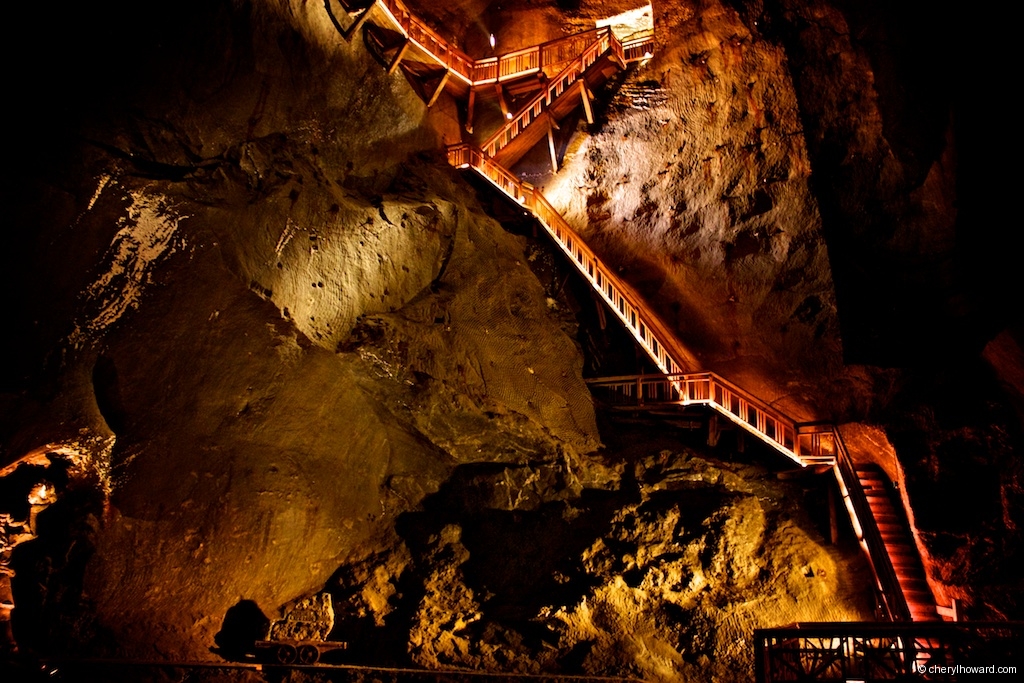
    Then, as we continued walking, things started to get more interesting. It finally felt that we were descending into Middle Earth, and it started to look and feel like we were in a real-life Lord of The Rings movie.

    Finally, the absolute best part of the entire tour is the rather iconic cathedral, all of which is entirely carved out of salt. Even the chandeliers are comprised of salt pieces. Weekly church services are held here and people even book weddings and other religious events in this deep underground location.

    Next, we were treated to some rather stunning views of some mine shafts.

    The tour ends, and you can purchase stuff from the gift shop. I picked up some rose-scented bubble baths containing salt from the mine, which reportedly yield great health benefits. You can also stop for lunch at the restaurant or gaze wonderingly at the ballroom, where wedding receptions and other events are held.

    What do you think about the Wieliczka Salt Mine? Would you visit this dark and deep underground location? Tell us more in the comments below.

    Location

    Good To Know

    1) It’s a really touristy place, so be prepared for a lot of people at the salt mine. Luckily, tours are spaced out, so it never feels too bad.

    2) Wear comfortable flat shoes, as there will be a lot of walking and stairs.

    3) If you want to visit the mines, check out their website for more information and have fun reading through their FAQ. This was my personal favorite (and not just for the obvious typo):

    Why cannot I touch and lick the salt sculptures?

    The salt sculptures not only adorn the Mine, but are also very valuable historic monuments (the oldest ones along the Tourist Route date from the 17th century), so we protect them with particular care. The salt sculptures are exposed to the leaching process, or humid air dissolving salt. Tourists who touch the sculptures contribute to accelerating their destruction.

    4) Admission prices vary, depending on whether you’re booked individually or with a group.

    5) More independent souls who aren’t into group tours can also easily reach the salt mine via public transit and buy a ticket upon arrival.

    6) Make your time in Krakow fun and take a tour. Try out these Krakow city tours.

    7) If you like travel in Poland, check out some of our top posts.

    *Disclosure – This post contains some affiliate links. If you book a tour, I’ll earn a tiny commission at no extra cost to you. Thanks for your support!

  • The 10-Z Nuclear Shelter In Brno, Czechia

    The 10-Z Nuclear Shelter In Brno, Czechia

    Brno has plenty of unusual things to see, like the ossuary filled with more than 50,000 skulls or the so-called Brno “dragon”. But one of the more curious attractions to visit in Brno, Czechia is the 10-Z Nuclear Shelter.

    10-Z nuclear shelter was first built by the Germans to defend against enemy attacks in WW2. It was then taken over by the Soviets who maintained it as a top-secret bunker until the early 1990s. Present day, the location serves as a bar frequented by locals, a hostel for travellers looking for an unusual place to stay, and a historical site one can tour to see what a nuclear shelter really looks like.

    Hot tip – if you really want to do know what things there are to do in Brno, read my comprehensive guide!

    The 10-Z Nuclear Shelter In Brno, Czechia

    Located in the center of Brno, just under Špilberk Castle, the bunker was initially constructed by the Germans during WW2 to defend against both American and Soviet bombs. After the war was over, the nuclear shelter was then used as a wholesale wine store, Löwy & Šmíd. 

    When the Soviets assumed control of Czechia after the coup in 1948, they confiscated the store and turned it into a top secret location to be used by local Communist party officials in the event a nuclear war occured. Construction efforts on the bomb shelter were completed by 1959 and plans were that the venue could house up to 500 people for up to 3 days and nights. Considering the entire shelter spans only 1,500 square meters, that would have been one crowded bomb shelter! The shelter remained under control of the Czech Army and was kept secret until 1993. 

    Fortunately for us, the bomb shelter never had to be put to its intended use.

    May this place never serve its original purpose. And may it remain vibrant with the sounds of good jazz.

    Hugo Marom

    10-Z Nuclear Shelter is now run by a non-profit company, AMERFO. Their purpose is to make what was once a commanding military space into something that’s accessible to the public, a place for them to come and learn about the history of the venue and connect to the individuals who were involved with the shelter. 

    10-Z Nuclear Shelter opened in 2016 and now operates as a retro themed hostel with 18 rooms. Not much was changed from the original Cold War look and feel – the same bunk beds are still in use and you can use some old school phones to contact reception. It’s not only a truly unique place to stay, but it also gives visitors a chance to really experience what it would be like to stay in a bunker. Note, bathrooms are shared and the bunker remains at a constant temperature of 14 degrees Celsius, so warm clothing is a must.

    There’s also an onsite bar, where you can kick back with a beer or listen to live performances.

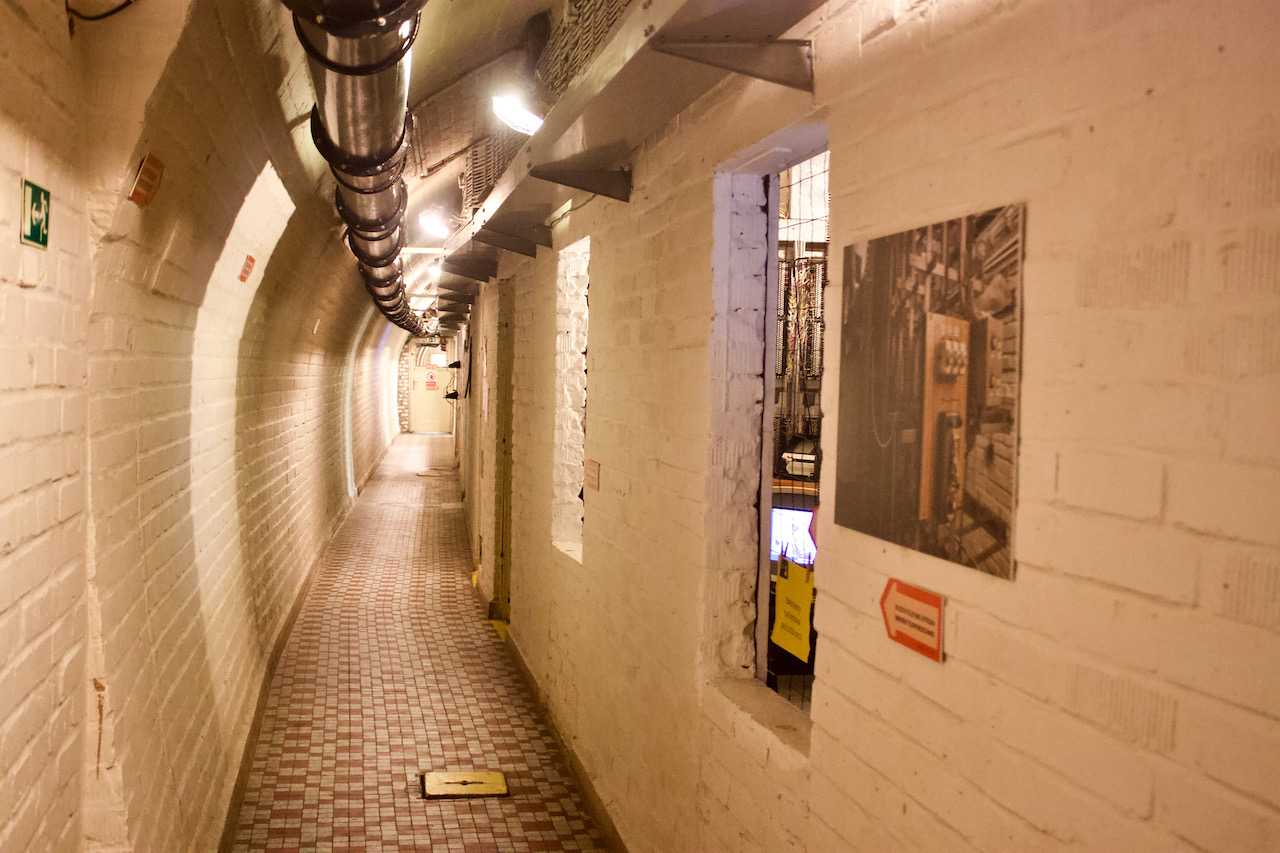
    You can tour the shelter, either alone or with a guide. If you go at it on your own, they’ll hand you a map at reception. There’s QR codes along the way, which you can use to watch videos and learn more about 10-Z’s history. Note, free wifi is available so no need to worry about wasting precious phone data. Tour highlights include seeing technical parts of the shelter like the diesel unit, filter room, and phone exchange. 

    Recommended reading: Read about (and then visit!) another bunker, the Denis nuclear bunker which only opened in 2021. 

    Watch/share this video about the 10-Z Nuclear Shelter and better yet, subscribe to my Youtube channel for even more travel related videos.

    What do you think about 10-Z Nuclear Shelter? Do you have any other tips for Brno? Tell us about in the comments.

    10-Z Nuclear Shelter Location

    Where is 10-Z Nuclear Shelter located? 10-Z Nuclear Shelter can be found at Husova, 602 00 Brno-střed, Czechia.

    10-Z Nuclear Shelter FAQ

    Everything you need to know about the 10-Z Nuclear Shelter in Brno. Let us answer your most common questions:

    1) How can I get in touch with the shelter for more information?

    You can call +420 515 919 793 and/or email [email protected].

    2) When is 10-Z Nuclear Shelter in Brno open? 

    For hostel guests, it’s open 24 hours a day. For those looking to do a tour, it’s opened from Tuesday – Sunday from 11:30 – 19:00. It’s closed for tours on Mondays. Get there by 18:15 latest to be able to complete a self guided tour before closing.

    3) How much does admission cost?

    A regular adult ticket is CZK 150 (about €6) and tickets for students, seniors, and people with disabilities is 100 CZK (about €4). Kids under 15 cost CZK 60 (< €3).

    4) Should I book in advance?

    If you want to do a tour on your own, you can just show up. If you want to do a guided tour, it’s recommended to book in advance. Free tours run from Tuesday – Sunday at 19:00. Tours are offered in Czech, but if you call in advance, you can request an English tour. Organized tours typically take about an hour and can be customized to your requirements, if you call and book ahead.

    5) Can I pay for my ticket with plastic?

    Yes, you can pay the entry free to 10-Z Nuclear Shelter with a debit or credit card.

    6) Can I take photos and videos inside the museum?

    Yeppers. There are no additional fees involved.

    7) How much time should I spend at the Brno Ossuary?

    As the bunker comprises about 500 meters of tunnels and there are videos to watch along the way, I’d say an hour would suffice.

    8) Is the 10-Z Shelter for children?

    Yes, it’s not at all scary. They may find it boring, though, and they may find it fun to roam through the tunnels and see the different rooms.

    Transportation Options In Brno

    All about how to get around Brno:

    1) To reach Brno’s city center, you can drive, take a taxi, or bus from the airport and main bus/train stations:

    • Trains arrive at Brno dolni nadrazi, the city’s main train station. You can use public transit to be in the city center within 15 minutes. Alternatively you can walk there within 20 minutes. You can also take a taxi – download the Liftago Taxi app to book a ride (Uber and Bolt don’t work here). A taxi will take about 10 minutes.
    • Buses arrive at Brno Zvonařka, the city’s primary bus station. Using public transit, walking, or taking a taxi will take approximately the same time as if you were coming from the train station (see above). 
    • Flights arrive at Brno–Tuřany Airport (BRQ). A bus into the city (E76) runs every 30 minutes throughout the day and will take about 20 minutes to be dropped off at the city’s main train station. A single ticket costs 25 CZK (€1). Driving or taking a taxi will take about 20 minutes to reach the city center. Note, taxi fares shouldn’t exceed €15.

    2) Some of the different ways to get around the city:

    • Bikes – Cycle your way around Brno with nextbike.
    • Public Transit – Visit Integrated Transport System of the South Moravian Region for details about the local public transit network.
    • Ride sharing – Use Liftago to move around the city.
    • Taxis – Use City Taxi Brno, Brno’s most popular taxi company. Tip – Have your hotel call them on your behalf, in case they don’t speak English. Liftago might a better option so you can get a car on your own without having to worry about language difficulties.
    • Driving – If you don’t have a car of your own, rent a car to make your way around Brno.  

    Where To Stay In Brno

    My recommendations about where to stay in Brno, Czechia:

    1) Take a look at places to stay with booking.com.

    Booking.com

    2) If you want to stay at 10-Z Nuclear Shelter, book here.

    Paying For Things in Czechia

    What you need to know about how to handle your money in Czechia:

    1) The country has its own currency, the koruna (CZK). 

    • Check xe.com to find out how your local currency fares against the Euro, US dollar, etc.
    • While most places will accept bank or credit cards, smaller shops sometimes only take cash. Get cash at a local bank machine. 
    • If you decide to pay by card, you may be asked which currency you want to pay in – choose to pay in the local currency (CZK), to save money on the exchange rate.

    2) Czechia is budget friendly, from accommodation, to dining out, and more. Read our guide about where to eat in Brno!

    Good To Know About Brno

    What else do you need to know about Brno? Here are some of our top tips for the city:

    1) To make your time in Brno memorable, book a guided tour through Get Your Guide.

    2) Is Brno safe? I can only answer this based as on my personal experience – as a woman travelling solo, I felt safe in Brno and didn’t encounter any difficulties. However, the experience for people of colour could be entirely different. It’s not the most ethnically diverse city and back in 2015, there was strong resistance to the mass refugee migration from locals. Read this interview, done in 2020 where people of colour in Czechia discuss their experiences.

    3) If you like unusual places around the world, take a look at some of my other related blog posts:

    *Disclosure – This post contains some affiliate links. If you book a tour or hotel, I’ll earn a tiny commission at no extra cost to you. Thanks for your support!

  • A Real Life Fairytale At Isola di Loreto In Italy

    A Real Life Fairytale At Isola di Loreto In Italy

    In the middle of the sparkling blue waters of Italy’s Lake Iseo, you’ll find one of the most magical and mysterious places in the world. Isola di Loreto (or Loreto Island) is one of those sites you wax poetic about, as it’s just that beautifully unique.

    Isola di Loreto is located in the province of Brescia, an area I’ve visited a couple of times and where I can’t get back to soon enough. Think about how to spend a perfect 24 hours in Brescia, what it’s like to wander the streets of Brescia, or sleep in some of the sexiest hotels in the city. 

    Why You Need To See Isola di Loreto In Italy

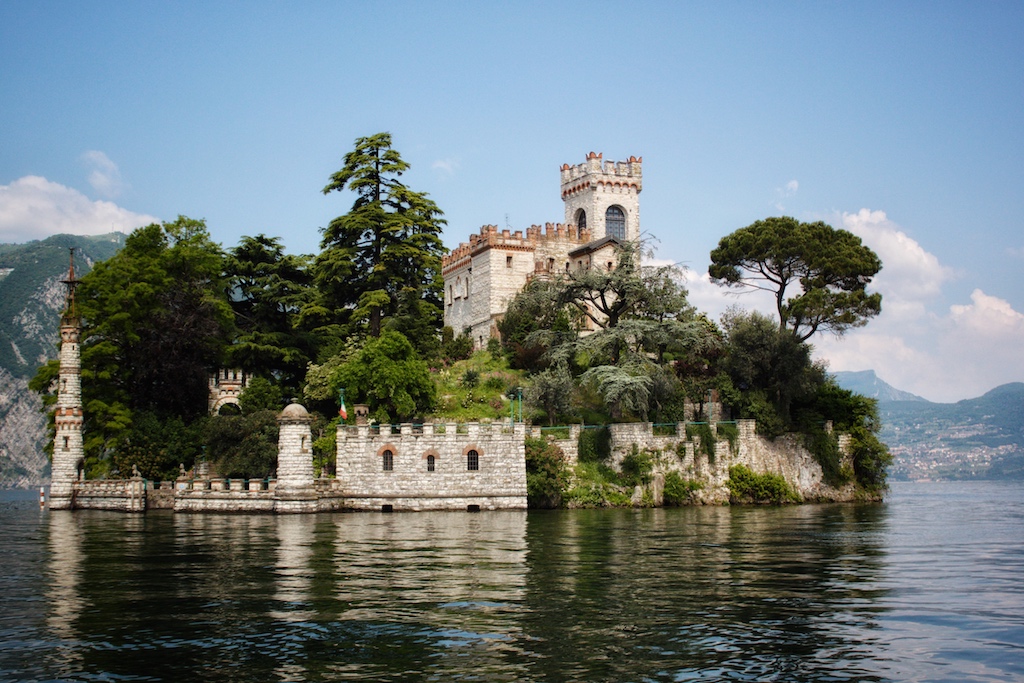
    Like a fairytale come to life, the small Loreto island is set amidst the dramatic background of snow-capped mountains and features a neo-gothic castle perched on the edge of a cliff, plenty of greenery, two lighthouses, and a marina. Outside of rare and special occasions, the owners of this private island currently don’t permit visitors. The island can only be admired from afar, by boat. 

    Recommended reading: This account, written by a woman who made her dreams come true when she visited the island to attend a jazz concert! Feel jealous as you read her account of the evening – she even got to meet and speak with the current owners.

    Isola di Loreto History 

    Some online accounts say there’s not much known about the tiny island’s history, but research shows otherwise, as there are plenty of stories to tell about Isola di Loreto.

    The first known documented instance of the island dates back to 1238, thanks to the discovery of some coins. These coins were an artifact of the Roman empire, from the time of Frederick II, a man with almost as many titles as Game Of Thrones’, Daenerys Targaryen. If you recall, she was the “Daenerys of the House Targaryen, the First of Her Name, The Unburnt, Queen of the Andals, the Rhoynar and the First Men, Queen of Meereen, Khaleesi of the Great Grass Sea, Protector of the Realm, Lady Regent of the Seven Kingdoms, Breaker of Chains and Mother of Dragons.” Frederick’s plethora of titles will also exhaust you – he was the King of Sicily, the King of Italy, the King of Germany, and the King of Jerusalem, as well as the Holy Roman Emperor. It was thought that during Roman times, the island was frequented by local fishermen, traders, and pilgrims. 

    During the 15th century, a group of Clarisse nuns, the Sisters of Saint Chiara of Brescia, bought the island, built a convent, took a vow of poverty to show their devotion to God, and lived a life of spiritual solitude on the property. When Cardinal Charles Borreomeo visited the island in 1580 and found that a hermit named Pietro was living there (he’d built his own home and tended to a ramshackle chapel), the Cardinal immediately closed down the convent and sent the nuns away. One wonders why the Cardinal didn’t allow the nuns and Pietro to continue to peacefully coexist. Was the hermit a playful flirt luring the nuns over to the “naughty side” or were one or more of the nuns romantically pursuing Pietro with reckless abandon? Maybe they were all just friends and Cardinal Borromeo was simply overreacting. 

    Loreto Island continued to be mentioned in the history books. Fast forward a wee bit to 1696 when Vincenzo Maria Coronelli, a Venetian geographer and renowned dude who made atlases and globes, noted that Isola di Loreto came into the hands of the heirs of Count Alessando Martinengo. In 1847, writer Constanzo Ferrari mentioned the island in his historical novel, Tiburga Oldofredi featuring two sibling protagonists, Tiburga and Imelda, from the noble Italian Oldofredi family. A short time later, historian Gabriele Rosa wrote about the island, mentioning the remnants of a longstanding fortress with two square towers and an east-facing chapel (parts of those ancient fortifications still remain on Isola Loreto today). A further reference to the island appeared in the Alpine Guide of the province of Brescia in 1889. 

    Eventually, Loreto Island was owned by Duchess Felicita Bevilacqua La Masa. This amazing woman deserves recognition for her contributions to the art world. Like most bold and forward-thinking females ahead of their time, she was said to be “troubled”, have an impetuous temperament, and a tendency to undertake an adventure. Born in 1822 as the oldest child of the once affluent Bevilacqua family, she grew up in a time when her family was facing severe financial problems. These problems persisted throughout her life, even until her death. Surprising everyone (she was not known to be a patron of the arts), she bequeathed Ca ‘Pesaro palace in Venice’s Grand Canal to the city so they could establish a studio for young artists with little financial means. The studio cum museum later exhibited the work of rebellious artists who showed their new and modern art, even showing some Cubist pieces.

    After the duchess’s death, the island was passed on to Royal Navy captain Vincenzo Richieri and his wife Giannina Zirotti. They commissioned architect Luigi Tombola to build the two-story neo-gothic castle, Castelo della Isola di Loreto, with crenelated turrets and light-colored stone walls. Tombola also oversaw the building of the marina and two lighthouses. To further accentuate the beauty of the castle, they filled the lake’s tiniest island with plenty of greenery, including pine and larch trees, as well as many exotic plants. 

    Isola di Loreto Now

    At the time of writing, the island is owned by a wealthy entrepreneur who hails from nearby Erbusco. The owner is said to have turned down several offers over the years from people wanting to buy the place. Rumors have it that back in 2010, George Clooney wanted to purchase the property for his former lover, Elisabetta Canalis. 

    The island remains completely off-limits to the public, with the owners rarely opening it for events such as jazz concerts. Who wouldn’t be willing to give one of their vital organs just to be able to attend a jazz concert on Isola di Loreto?

    Recommended reading: Our review of the nearby Hotel Rivalgo in Sulzano. This hotel is a stunning and calming sanctuary resting on the shores of Lake Iseo. It’s the perfect place to base yourself and nearby visit Monte Isola or Loreto Island. 

    To see how the island looks from above, view this Youtube video with drone footage set to some rather cheesy piano music. 

    Even better, watch/share this video about Isoloa di Loreto, and better yet, subscribe to my Youtube channel for even more travel-related videos.

    What do you think about Isola di Loreto? Are you keen to visit this stunning place? Let us know and leave a comment down below. 

    Location

    Isola di Loreto
    25050 Monte Isola, Province of Brescia, Italy

    (The island is close to Monte Isola, opposite Carzano in the province of Brescia)

    Good To Know

    1) Browse hotel offerings in the Lake Garda area.

    Booking.com

    2) Experience the Lake Iseo and Lake Garda areas with a guided tour.

    3) If you’d like some further Italy travel inspiration, read these fabulous blog posts:

  • River Surfing in Munich Germany, A Landlocked City

    River Surfing in Munich Germany, A Landlocked City

    When thinking of Munich, rather stereotypical images of beer, sausage, and Oktoberfest outfits often come to mind. Surfing in a river certainly does not. A city located 500 kilometers from the coast and 1,100 kilometers from any surfable waves, it’s hard to believe that such an extreme sport like this is possible within an urban setting.

    River Surfing in Munich Germany, A Landlocked City

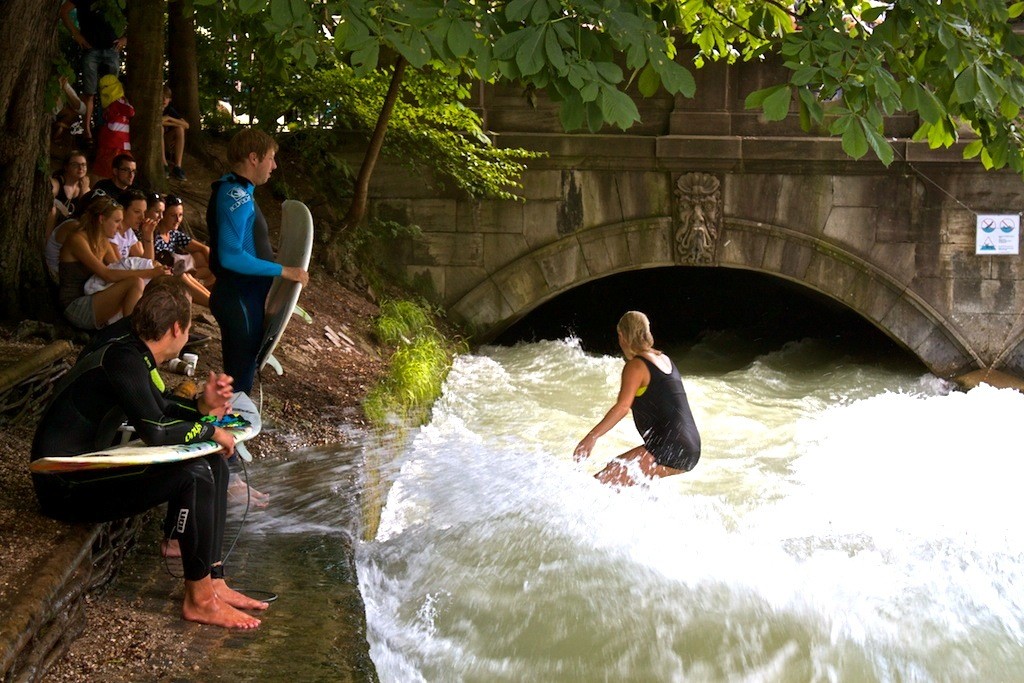
    Walking through the English Gardens (Englischer Garten), you get a general sense that locals love soaking up the rays in the Eisbach River. Take for example, the boys in the photo above, waving an enthusiastic hello when they spied me taking photos. Then there was one guy standing in river, perfecting his surfing moves. Some older men also lazily floated along the river’s strong current.

    Yet there’s one place where the current is especially strong. Located below a six lane highway in Munich, enthusiasts from around the world come to surf the one meter wave.

    Munich River Surfing

    They surf daily and even at night, much to the admiration and respect of onlookers like myself. I was amused to see a bride-to-be celebrating her bachelorette party, and I personally congratulated this surfer while others watched from the bridge above.

    River surfing is regarded as a new sport by some, but the river surfing in Munich has been going strong since the 1970s. There’s even a strong Munich Eisbach river surfing community and the Santoloco Surf and Skate Shop, which sells specialized boards for surfers eager to hit the river wave. In fact, the surfers are so hardcore that they even surf during winter months. I also recommend watching this fun video for a glimpse into the local action.

    Although it may look like a fun thing to do (even little old me was tempted to jump on a board and give it a go), only experienced athletes are allowed to surf in the narrow 12 meter wide river. Water flows at a fast and furious pace of around 25 square meters per second!

    It’s easy to get caught up in all the action and stand there for hours staring at this very weird and wonderful site. I stayed for about an hour and snapped more than 150 photos! To really get a feel for what it’s really like, give this river surfing video a watch or best of all, go see it for yourself.

    Have you seen this river surfing in Munich? What else did you do in the city? Leave our readers with your best tips in the comments down below!

    Location

    Good To Know

    1) Find a place to stay while you’re visiting Munich, Germany.

    Booking.com

    2) Make your vacation in Munich memorable and take a guided tour.

    3) If you love Europe as much as I do, check out some of my top blog posts.

    *Disclosure – This post contains some affiliate links. If you book a tour or hotel through any of these links, I’ll earn a tiny commission at no extra cost to you. Thanks for your support!

  • Book Lovers Should Go To Petrivka Book Market In Kyiv

    Book Lovers Should Go To Petrivka Book Market In Kyiv

    Note: While the unjust war in Ukraine rages on, we’re leaving this post here with the sincerest of hopes that peace arrives and this book market will live on and be enjoyed once more. In the meantime, find out about how you can help Ukrainians in Berlin.

    If you’ve been following my blog for a while, you’ll know that I absolutely love to visit bookstores and libraries whenever I travel. From the Instagrammable cultural hotspot, Cărturești Carusel in Bucharest, to the books stuffed in boats at Libreria Acqua Alta in Venice, and a bookstore in Detroit filled with more than 1,000,000 second-hand titles, these are my happy places.

    When visiting Kyiv, a local resident gave me some cool tips about some unusual places to check out, including the Museum of Toilet History, as well as a recommendation to visit Ukraine’s largest book market, the Petrivka Book Market. 

    Book Lovers Should Go To The Petrivka Book Market In Kyiv

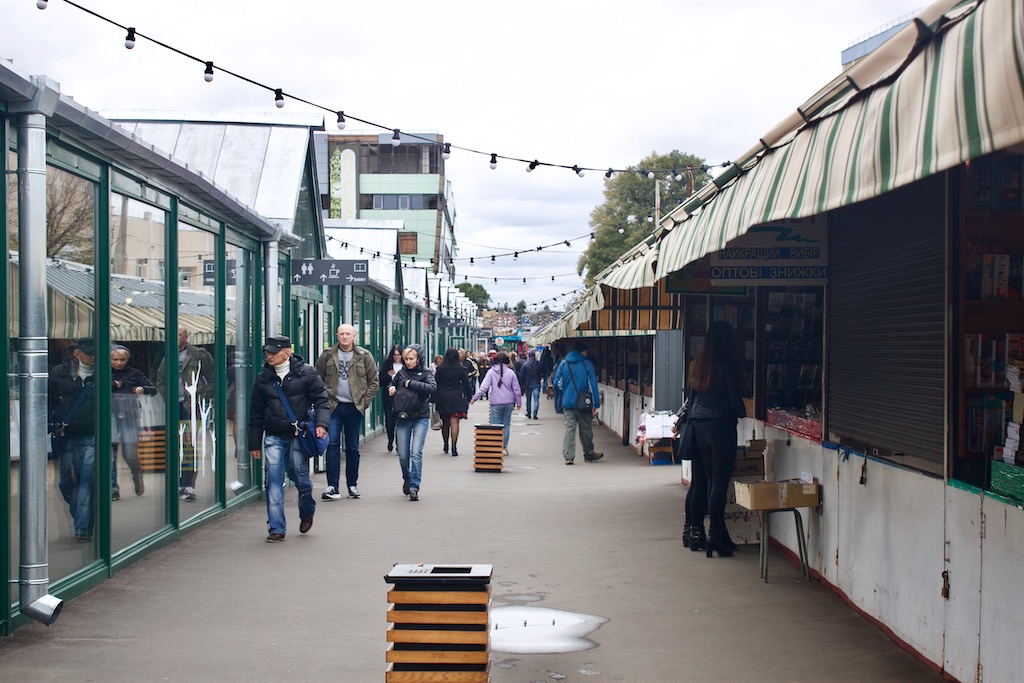
    If you’re looking for a little something off the beaten path to do while you’re in Kyiv, head to the Petrivka Book Market. This gigantic open air market spans 1000 square meters and is filled with more than 100,000 titles, making it Ukraine’s largest book market. Petrivka also happens to be Kyiv’s oldest market.  

    Recommended reading: Find out the best markets to explore in Kyiv for fresh food, vintage clothes, and more and check out this guide to thrifting in Kyiv.

    Aside from books both new and secondhand, you’ll find a bizarre assortment of CDs, DVDs, records, software of dubious origins, party supplies, paint by number sets, and more. 

    While the vastness of the market can seem overwhelming (there’s more than 167 shops, each selling anywhere from 2,000 – 3,000 books), and the rows of bookstalls start to feel the same after a while, it’s a fun way to spend a couple of hours. Especially because Petrivka book market is a place for locals (mostly pensioners) and not tourists! There’s live music, stalls where you could buy coffee, and even cozy nooks where you could sit and relax for a while.

    Most books in Ukraine are actually not sold in retail shops, but in markets like Petrivka where used books remain affordable to the average person. In recent years, the demand for secondhand books has substantially increased as purchasing new books is now considered a luxury buy for many. These markets are not only community institutions, but a vital way to provide literature to Ukrainians at a nominal price.

    There are rumours that the Petrivka book market will be shut down and be replaced by yet another soulless shopping center, so visit this place while it’s still around! Even more sad, is that this appears to be a growing trend – read, Retail Pressures: Ukraine’s Open-Air Bookselling Marketplaces Appear Headed for Closure for more details.

    Watch or share this video about the book market and better yet, subscribe to my Youtube channel for even more travel related videos.

    Would you hang out at the Petrivka book market while you’re in Kyiv? Can you recommend other offbeat attractions in the city? Let us all know by leaving a comment below. 

    Petrivka Book Market Location

    Where is the Petrivka book market? Vulytsya Verbova, 17, Kyiv, Ukraine, 02000.

    Petrivka Book Market FAQ

    What do you need to know before you visit the Petrivka book market in Kyiv? We answer some of the most common questions.

    1) What are the hours of operation? The market is open daily from 9:00 – 17:00. It’s closed on national holidays.

    2) What’s the closest metro station?  The nearest metro station is Pochaina metro station (formerly known as Petrivka) on the Obolonsko–Teremkivska line.

    3) Can you find English books at the Petrivka book market? As this is a market catered to locals and not tourists, most books are in either Ukrainian or Russian. This also means most shop owners do not speak English either. You can still find a small selection of books in English, but you really need to look for them. I picked up a few awesome travel guides to Kyiv, Odesa, and Lviv at a shop called Bookling but found them to be on the expensive side. I may have gotten slapped with a “tourist tax” or English books are a higher price due to their limited availability.

    4) How much time do I need for the market? I’d recommend at least an hour for the book market, and another hour or so for the nearby flea market. Hot tip – check out the flea market for yes, a lot of junk, but also all sorts of treasures.

    5) Is the market safe? Yes. As a woman walking around alone, I never once felt unsafe. People stared at me sometimes, as I definitely looked like a tourist when I was snapping photos, but no one bothered me. Note, I cannot speak about how your experience could be as a person of color at the market, in Kyiv, or while traveling through Ukraine.

    Transportation Options In Kyiv 

    How to get around Kyiv, Ukraine:

    1) To get to Kyiv’s city center, you can take a train, taxi, or bus:

    • From the airports – Kyiv’s primary airport is Kyiv Boryspil Airport (KBP), which is 36 kilometers from the city center. You can take a train from Terminal D, which will take about 40 minutes and bring you to the main metro station, Vokzal. A ticket will cost you 80 UAH. This is the cheapest, quickest, and easiest way to get into Kyiv, as the city is congested with such heavy traffic that bus or car travel is not the most optimal way to travel. If you’re still determined to take a bus, you can take the Sky bus (#322) which runs all day from each of the terminals. The journey will take about an hour or more and bring you to the main station. A bus ticket is 100 UAH. You can also get a taxi from the airport, with prices starting at around 300 UAH. A taxi ride will be about 40 minutes or more. The city also has a second airport, Kyiv Zhuliany Airport (IEV), only eight kilometers from the city center. As it’s so cheap, you might as well take an Uber from the airport to your hotel, hostel, or whatnot. 
    • From the main train station – The city’s main railway station, Kyiv Passazhyrskyi, is located in the heart of the city. Call an Uber to get where you need to go. 
    • From the main bus terminal – The main bus station is at Demiivska Square. It’s not exactly in the city center, but it’s also not that far. Again, we recommend taking an Uber.

    2) There are numerous ways to make your way around Kyiv:

    • Taxis – As taxi scams are plenty, skip taking a taxi. If you don’t speak fluent Ukrainian, they will most certainly pick up on the fact you’re a tourist and charge you exorbitant prices. If you still prefer to take a taxi, popular companies include Uklon, Hopin, and CabLook Taxi. To be on the safe side, have your hotel call them for you versus hailing one yourself, and don’t be hesitant to negotiate the quoted price down.
    • Ridesharing – Both Bolt and Uber are available in Kyiv. Due to having a fractured foot, I used Uber to get around Kyiv throughout my entire time there. It was super cheap and a convenient way to get around the city.
    • Bikes – You can rent bikes when you’re in Kyiv, from sharing services like nextbike. Unless you’re a serious cyclist, we’d advise against cycling your way around the city. It’s not exactly the most bike-friendly city, as the streets are made to serve motorists. Not to mention, the city is very hilly and biking will be a tough effort, to say the least.
    • Public Transit –  You can take the metro, which has three lines and 52 stations. Hours of operation are from 6:00 until midnight daily. One ticket will run you 8 UAH. Kyiv has some of the deepest metro stations in the world and the Soviet architecture in the stations are well worth checking out. You can also travel by bus, trolley bus, or tram, and as with the metro, tickets are 8 UAH each. Note, buses tend to get crowded so it may be best to avoid traveling this way during Coronavirus. If you’re really into having local experiences, you can take privately owned mini buses, called Marshrutky. You can even travel by funicular to get from the upper city down to Podil, or vice versa. The view of the city and the Dnieper during the ride is said to be fantastic. The funicular runs from 6:00 – 23:00 in summer and 7:00 – 22:00 come winter. The cost of a single ticket is 3 UAH. 
    • Driving – If you feel confident enough to drive in Kyiv, (the locals drive a bit like maniacs!), rent a car.

    Where To Stay In Kyiv

    What are some of Kyiv’s best accommodation choices?

    1) Stay in a hotel, hostel, or private apartment while in Kyiv. 

    Booking.com

    2) When I was in Kyiv, I stayed at ibis Kiev City Center. I was lucky enough to score a room on a high floor that offered a spectacular view of Kyiv. While this hotel chain isn’t the style of the hotel I typically choose, the deal was too good to resist costing about €180 for three nights. Aside from that, the hotel’s centrally located, the bed was large and comfy, and the restaurant served up a fairly decent breakfast.   

    Paying For Things In Ukraine

    Tips and tricks to help you handle your money and cards when you’re traveling in Kyiv and beyond:

    1) Ukraine has its own currency, the Ukrainian hryvnia (UAH). 

    • Check xe.com to find out how the local currency fares against the Euro, US dollar, etc.
    • While most places will accept bank or credit cards, smaller shops often only take cash. Get yourself some cash at a local bank machine. Note, many times bank machines are only accessible when banks are open and are closed when the bank closes. Be sure to get your money as early in the day is possible. 
    • If you do pay by card, you’ll be asked which currency you want to pay in – choose to pay in the local currency (RSD), as you’ll save money on the exchange rate.

    2) Ukraine is way cheaper than other destinations in Europe and you’ll find that your money goes a long way here, including your accommodation, eating out, and more.

    3) As always, if you can avoid it, wait to exchange your money somewhere in the city (you’ll find tons of places to do so). The exchange rate at the airport tends to be quite high. 

    Good To Know About Kyiv 

    Important things to know when you’re in Kyiv:

    1) Kyiv is a city full of motorized vehicles. I haven’t visited such a car-crazy city since I visited Bangkok! If you’re getting around by car, which you likely will be at some point, give yourself a long time to get anywhere as you’ll likely get stuck in one or more traffic jams. Take into account the extra travel time when coming from or going to the airport.

    2) A few years ago, a law was passed to enable free data roaming wherever you go in the EU. As Ukraine isn’t part of the EU, you’re either going to need to take advantage of free wifi when you find it, buy a local sim card, or rack up excessive data roaming charges. You can find sim cards at both airports.

    3) If you like traveling in Eastern Europe, you may want to check out some of the blog’s more popular posts:

    *Disclosure – This post contains some affiliate links. If you book a tour or hotel, I’ll earn a tiny commission at no extra cost to you. Thanks for your support!